Changeover Switches: Industrial Selection Guide, Types, Specifications & Comparison

When grid power fails at your manufacturing facility, an inadequate changeover switch, such as a manual changeover switch, can cause a complete operational shutdown, leading to costly downtime averaging $5,000–$50,000 per hour. This guide is positioned specifically for procurement managers, focusing on selecting the right changeover switch for business continuity, equipment protection, and compliance with regulations in industrial and commercial settings—not just a basic explanation.
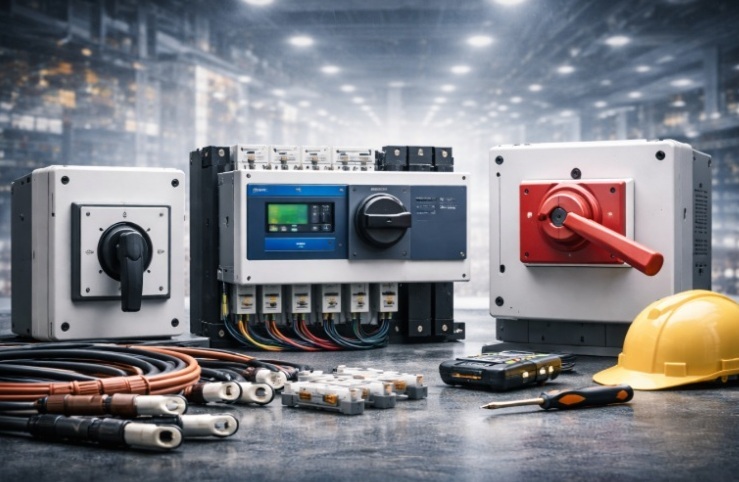
When the main power source fails, a changeover switch disconnects the main power and transfers the load to a backup source. This transition ensures continuous power supply with minimal disruption. An automatic transfer switch (ATS) is designed to detect power failure automatically and initiate the switch to backup power, offering a seamless and reliable solution for critical power management.
Step-by-Step Power Switching Flow:
- Power failure detected
- Main supply isolated
- Backup source activated
- Load transferred
- Power restored
The specification framework for changeover switches should emphasize reliability to prevent transfer failures during outages. Focus on appropriate amperage ratings with 25% capacity headroom, breaking capacity ratings of 10kA or higher, and IP65-rated enclosures. Manual switches are suitable for delays of 5–30 seconds, while an automatic transfer switch (ATS) is essential for mission-critical loads requiring transfer times typically under 10 seconds, with high-end systems offering near-instantaneous switching. Verify IEC compliance and UL 1008 certification documentation upfront to ensure seamless backup power activation and avoid extended outages.
Types of Changeover Switches: Manual vs Automatic Transfer Systems
Understanding changeover switches involves assessing how each type meets operational needs. The main distinction lies in human dependency and switching speed, which directly impact downtime risk and continuity.
Manual Changeover Switches
Manual changeover switches require physical operation to switch power between grid and backup sources. An operator must flip a handle or turn a dial to switch from utility power to generators or alternative supplies.
- Cost-effective installations: Manual switches are 50-70% less expensive than automatic systems and require minimal maintenance.
- Non-critical applications: Suitable for residential and small commercial setups where 5-30 second transfer delays are tolerable.
- Space-constrained projects: Designed to handle 30-200A loads in compact spaces.
- User-controlled scenarios: Ideal when operators need to assess conditions before power transfer.
Motorized Changeover Switches
Motorized changeover switches offer a semi-automatic or remote-controlled option that bridges the gap between manual and ATS systems. They are particularly suited for mid-scale industrial setups that require more reliability than manual systems but do not justify the full automation of an ATS.
- Remote operation: They can be operated remotely, providing flexibility and quicker switching compared to manual switches.
- Mid-scale industrial setups: Ideal for facilities that need a balance between cost and automated response.
- Positioned between manual and ATS: Offers a compromise in automation for those not ready to fully transition to automatic systems.
Automatic Transfer Switches (ATS)
An automatic transfer switch (ATS) monitors primary power and executes transfers without human intervention. They detect outages, switch to backup sources, and restore utility power when available. For more details on ATS systems, explore additional information on ATS systems and related power distribution components.
- Mission-critical facilities: Essential for hospitals and data centers wherepower interruptions affect safety or data integrity, typically handling 400A-4000A for data centers and 200A-2000A for hospitals.
- Instantaneous response: Transfer times typically under 10 seconds minimize disruption to sensitive equipment, with high-end systems offering near-instantaneous switching.
- Unmanned operations: Critical for facilities operating off-hours or in remote locations.
- Built-in monitoring: Advanced systems provide real-time power quality data and transfer event logging for compliance.
- Cost context: ATS systems typically cost 2–3 times more than manual switches, but they justify the additional expense by significantly reducing downtime and operational risk associated with power failures.
How to Select the Right Changeover Switch: Critical Decision Framework
Selecting the right changeover switch requires considering electrical performance, regulatory compliance, and operational reliability against project budgets and timelines. Move beyond basic load matching to account for system fault levels, environmental conditions, and integration requirements that impact long-term operational costs.
Future-Proofing Guidance
When selecting changeover switches, plan for future load expansion by factoring in capacity growth. Consider investing in smart or monitoring-enabled automatic transfer switches (ATS) that provide advanced oversight and diagnostics capabilities. Ensure compatibility with alternative energy sources such as solar systems and generators, which can be integrated into your power management strategy to enhance sustainability and resilience.
Your selection process begins with a comprehensive electrical load analysis. Calculate total connected load by inventorying all devices and their power requirements, then account for inrush current during transfer events, which can range from 3–6 times normal operating load.
|
Selection Parameter |
Light Commercial |
Industrial |
Mission-Critical |
|
Load Capacity Range |
63A–200A with 25% margin |
200A–1600A with 30% margin |
400A–4000A with 40% margin |
|
Transfer Speed Requirement |
5–15 seconds acceptable |
2–10 seconds preferred |
<1 second mandatory |
|
Pole Configuration |
3-pole standard |
4-pole for neutral switching |
4-pole with ground monitoring |
|
Switching Mechanism |
Manual or motorized |
Automatic preferred |
Automatic with bypass |
|
Compliance Standards |
IEC 60947-6-1 basic |
IEC + local codes |
Full IEC/UL 1008 certification |
|
Short-Circuit Withstand Rating |
10–25 kA |
25–50 kA |
50–100 kA |
|
IP/Enclosure Rating |
IP44 indoor |
IP54 industrial |
IP65 harsh environment |
|
Typical Applications |
Retail, small offices |
Manufacturing, warehouses |
Data centers, hospitals |
Cost-driven undersizing creates asymmetric risk that procurement teams must quantify for stakeholders.
Manual vs Automatic Changeover Switches: Detailed Comparison
Beyond the initial purchase price, the true cost of changeover switches lies in their operational impact during failures. A manual changeover switch requires operator intervention and has lower upfront costs, while automatic switches offer near-instantaneous power restoration without human involvement.
The choice between these systems revolves around risk tolerance, operational resilience, and total cost of ownership. Manual switches are attractive for budget-conscious operations with predictable outage patterns, whereas automatic systems reduce downtime and eliminate the risk of human error.
|
Factor |
Manual |
Automatic |
|
Initial Cost |
Lower; minimal installation complexity |
Higher; requires specialized installation |
|
Transfer Speed |
5–30 seconds (operator-dependent) |
Under 10 seconds, with high-speed options available |
|
Operator Requirement |
Requires on-site personnel availability |
None; fully autonomous operation |
|
Reliability |
35% higher back-feed risk due to human error |
Mechanical interlocks prevent dangerous back-feeding |
|
Maintenance |
Minimal ongoing requirements |
Regular testing and service intervals |
|
Downtime Risk Impact |
~85% uptime (variable based on response) |
~99.9% uptime |
|
Compliance Suitability |
Small commercial, non-critical loads |
Hospitals, data centers, critical infrastructure |
|
ROI |
Cost-focused for tolerance environments |
40% reduction in downtime costs for switching organizations |
For facilities where every minute of downtime equates to lost revenue or safety risks, automatic systems provide quantifiable returns. Manual switches remain feasible where operational staff can quickly respond and brief interruptions don't compromise critical processes.
Critical Applications: Where Changeover Switches Prevent System Failure
Changeover switches serve as the final line of defense against power disruption in industries where downtime leads directly to financial loss or safety risks. Utilizing an industrial changeover switch can further enhance reliability and performance in harsh conditions.
Data Centers and IT Infrastructure
Data centers demand 99.999% uptime to prevent data loss and service interruption. Automatic Transfer Switches (ATS) with interlocking mechanisms ensure zero-downtime power transfer between grid and backup generators, typically handling 100-4000A for server loads.
Healthcare and Hospital Facilities
Hospitals require immediate backup for life-support systems during outages. ATS units provide seamless transitions for critical equipment, usually rated 200-2000A, for ventilators, ICUs, and surgical equipment.
Industrial Manufacturing Plants
Manufacturing operations need reliable grid-to-generator switching to maintain production continuity. Three-way manual or ATS hybrid systems manage 400-6300A loads for heavy machinery and assembly lines, often requiring the durability of an industrial changeover switch.
Real-World Failure Scenario: Delayed Transfer Due to Incorrect Switch Selection
An example of real-world failure can be seen in an industrial manufacturing plant where the wrong type of changeover switch was selected, leading to avoidable production downtime. In this plant, a manual changeover switch was installed in the belief that downtime would be manageable. However, following a sudden power outage, the delay in transferring to backup power caused significant production losses, highlighting the need for automatic solutions in environments where speed in power restoration is critical.
Oil & Gas and Hazardous Locations
Hazardous environments require explosion-proof isolation with IEC 60947-6-1 compliance. ATS systems rated 1000-4000A handle pumps and drilling equipment while meeting GCC dust and heat specifications.
Commercial Buildings and Mixed-Use Developments
Commercial facilities need redundant supplies for elevators and lighting systems. Manual or ATS configurations offer flexibility for 63-1600A loads, balancing cost with reliability.
How AGEA Streamlines Changeover Switch Procurement for Industrial Projects
Procuring the right changeover switches involves navigating complex supplier networks, verifying technical specifications, and ensuring compliance, all while meeting tight deadlines. AGEA streamlines this process.
Differentiating Risks with Generic Suppliers
When dealing with generic suppliers, several risks can threaten project timelines and operational integrity:
- Counterfeit Products: Using unverified suppliers can expose projects to counterfeit or substandard products, potentially leading to failures and safety hazards.
- Compliance Delays: Generic suppliers may lack the necessary compliance and certification, causing holdups in regulatory approvals and installation.
- Stock Uncertainty: Inconsistent inventory levels can lead to unexpected stockouts, delaying project completion and operational readiness.
Authorized Access to Tier-1 Industrial Brands
Direct manufacturer relationships eliminate counterfeit risks and sourcing delays. AGEA provides exclusive access to premium changeover switch manufacturers like GEYA, ensuring high-reliability products directly from verified Tier-1 suppliers.
Technical Specification and Selection Support
Expert guidance prevents costly specification mismatches that derail projects. AGEA's technical team supports ATS specifications, including microprocessor-based controls for voltage and frequency monitoring tailored to your industrial needs.
Real-Time Stock Visibility and Fast Delivery
Live inventory tracking eliminates stockouts that halt project timelines. AGEA offers real-time inventory visibility and rapid shipping, enabling same-week fulfillment for urgent installations.
Instant Quotation and LPO Processing
Digital procurement eliminates weeks-long quote delays. AGEA streamlines quotation and LPO approval processes through digital platforms, delivering responses in minutes with factory-direct pricing.
Compliance Documentation and Certification Verification
Pre-verified certifications prevent delays and audit failures. AGEA verifies certifications like UL/cUL 1008 for all changeover switches, ensuring compliance documentation for audits.
Common Procurement Mistakes to Avoid When Specifying Changeover Switches
Errors in changeover switch specification can lead to failures that compromise power reliability. The following are five critical mistakes to avoid:
- Undersizing Load Capacity Based on Average Usage
Specifying switches using only average load calculations ignores peak demand scenarios. Air conditioning systems, industrial motors, and compressors create load spikes that exceed underrated switches.
- Ignoring Inrush Current Requirements
Overlooking starting current demands leads to switches that cannot handle transient peaks during startup.
- Choosing Manual Switches for Critical Operations
Selecting manual changeover switches for critical processes creates dangerous response delays.
- Failing to Account for Future Load Expansion
Specifying switches without considering growth forces expensive replacements within 2-3 years.
- Overlooking IEC Compliance and Certification Requirements
Procuring non-compliant switches creates regulatory violations and liability exposure. Proper IEC certification verification ensures global safety standards.
FAQ: Changeover Switch Selection and Procurement
What load capacity changeover switch do I need for my facility?
Calculate your total electrical load and add 25% headroom to peak demand. Always size above your calculated load to prevent overheating.
What's the difference between 3-pole and 4-pole changeover switches?
The pole count determines how many conductors the switch controls. Single-phase circuits use 2-pole switches, while three-phase systems require 3-pole or 4-pole configurations.
How do I choose between manual and automatic transfer switches?
Manual switches require human intervention and suit non-critical loads, while automatic transfer switches (ATS) activate instantly when power fails.
What transfer time is acceptable for different applications?
Data centers and hospitals require sub-10-second transfer times. Office buildings and commercial spaces usually accept 30-60 second delays for non-essential loads.
Are manual changeover switches compliant for commercial buildings?
Manual switches are acceptable for non-critical applications but may not meet code requirements for critical systems.
What brands of changeover switches are most reliable for industrial use?
Schneider Electric, Eaton, and ABB offer proven industrial-grade changeover switches. Authorized distributors like AGEA provide access to these brands.
Can I use a manual changeover switch in a data center?
Manual switches are not recommended for mission-critical loads due to delays and human dependency.
How do I verify IEC compliance for changeover switches?
Look for IEC 60947-6-1 certification on the product nameplate and documentation.
Do changeover switches support solar and generator integration?
Yes, they transition between multiple power sources, including generators, solar systems, and grid electricity.
What's the typical lead time for industrial-grade changeover switches?
Standard manual switches typically ship within 1-2 weeks; custom-configured automatic switches may require 4-8 weeks.
What is the difference between ATS and changeover switch?
The main distinction between an Automatic Transfer Switch (ATS) and a general changeover switch is automation and functionality. An ATS automatically detects a power failure and initiates the switch to a backup power source without human intervention, providing seamless power continuity. In contrast, a manual changeover switch requires physical operation by an operator to transfer power, which depends on human presence and may lead to transfer delays.
Conclusion: Selecting Changeover Switches That Protect Your Operations
Choosing the right changeover switches is not just a procurement decision—it's your first line of defense against operational catastrophes. Poor switch selection results in costly downtime across industries, with healthcare facilities alone losing $800 million annually. The right choice enhances efficiency and reliability through seamless power transitions.
AGEA's 50+ years of industrial expertise ensures you specify switches that match your actual operational needs. Our real-time inventory visibility and authorized access to tier-1 brands eliminate procurement delays that leave critical systems vulnerable.
Don't let power transfer failures compromise your operations. Explore changeover switches and get an instant quote to protect your facility with the right switching solution.
About the Author

Related Posts
Circuit Breakers in UAE: Types, Standards & Selection Guide for Contractors