MCB Breaker Types (A, B, C, D): Selection Guide for Industrial & Commercial Applications

Choosing the right MCB (Miniature Circuit Breaker) type is crucial for procurement managers, engineers, contractors, and system integrators involved in industrial and commercial projects. Issues such as frequent interruptions from mismatched types can lead to significant failure rates in commercial motor applications. Incorrect specifications can result in equipment damage and protection failures during high-inrush scenarios in HVAC systems. This guide helps align trip characteristics, whether Type B for resistive loads, Type C for motors, or Type D for heavy machinery, with specific electrical demand requirements, initial surge current behavior, and application needs, preventing costly downtime and ensuring reliable circuit protection.
Introduction: Why MCB Type Selection Matters for Circuit Protection
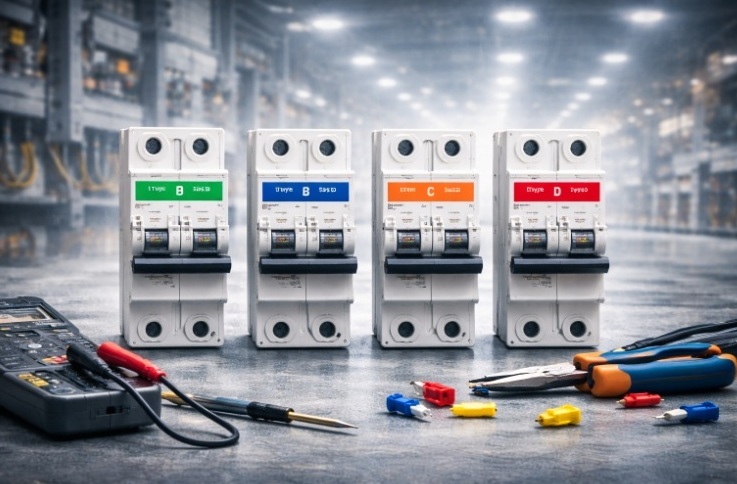
Miniature Circuit Breakers (MCBs) automatically interrupt electrical circuits during overloads or short circuits, protecting systems from damage and fire hazards. Choosing the right MCB type is not merely about selecting one with the correct current rating; it fundamentally depends on understanding how different breakers interact with load characteristics. When specifying types of MCB breakers, you choose trip curve classifications, reflecting MCB tripping characteristics. Type B trips at 3-5 times the rated current for resistive loads, Type C at 5-10 times for inductive applications, and Type D manages high inrush industrial equipment. This system dictates how quickly the breaker responds to overcurrent conditions.
Choosing the wrong MCB type can result in immediate operational issues and long-term safety risks. Type B breakers on motor circuits can lead to unnecessary shut-offs due to inrush currents, while undersized types might fail to interrupt faults, causing overheating and potential fires. Such mismatches cause frequent system downtime and emergency service calls.
Choosing the right MCB type ensures protection is aligned with actual system demands rather than assumptions. The difference between reliable operation and constant troubleshooting often lies in understanding how your specific loads interact with the trip characteristics during normal and fault conditions.
Understanding MCB Trip Curves: The Foundation of Type Classification
MCB trip curves show the relationship between fault current and tripping time, forming the technical basis for choosing between Type B, C, and D breakers. These curves plot current as multiples of the rated current (In) against response time.
MCBs operate through two protection mechanisms. The thermal region handles overload conditions using a bimetallic strip. The magnetic region provides instantaneous short-circuit protection through a solenoid mechanism, activating quickly when faults occur.
The magnetic trip thresholds define MCB type classifications: Type B trips at 3-5× In, Type C at 5-10× In, and Type D at 10-20× In. Understanding these thresholds allows matching the breaker's sensitivity to current characteristics—preventing undue trips while maintaining fault protection. This relationship impacts system reliability and efficiency.
To simplify, you can think of the types as follows:
- Type B: Sensitive, like a person who wakes up at the slightest noise—ideal for resistive loads with minimal surges.
- Type C: Balanced, like someone who sleeps through minor disturbances but wakes up to more significant noise, suitable for general commercial use with mixed loads.
- Type D: High tolerance, like a heavy sleeper who needs a loud alarm to wake up, best for heavy industrial machinery with strong inrush currents.
The Three Standard MCB Types: B, C, and D Explained
Type B MCB: Low Inrush Current Applications
Type B MCBs trip at 3-5 times the rated current, ideal for resistive loads like lighting circuits, electric heaters, and standard outlet circuits. These breakers respond quickly since resistive loads have minimal startup surge.
Best for residential installations and circuits with predictable current draw. Avoid using Type B MCBs when dealing with inductive loads like motors or transformers due to the risk of unnecessary interruptions during startup.
Type C MCB: General Purpose Commercial Use
Type C MCBs trip at 5-10 times the rated current, managing moderate inrush currents from motors, pumps, fans, HVAC systems, and fluorescent lighting. This trip range accommodates 5-8 times startup current typical of commercial equipment.
Perfect for mixed commercial loads, combining both resistive and moderate inductive equipment. Avoid using Type C MCBs when applications involve high-inrush industrial equipment exceeding the 10x current threshold.
Type D MCB: High Inrush Industrial Loads
Type D MCBs trip at 10-20 times the rated current, designed for heavy inductive loads like large motors and transformers. These breakers delay tripping to allow safe equipment startup.
Essential in industrial settings where motors draw 10-14 times the rated current during startup. The extended trip time prevents interruptions while maintaining short-circuit protection. Avoid using Type D MCBs when dealing with general-purpose circuits as the slower response reduces effectiveness for typical loads.
Real-world Examples:
- HVAC Systems: Type C MCBs effectively manage the inrush currents from compressors in HVAC units, ensuring smoothly operating air conditioning systems.
- Panel Boards: Widely used in commercial installations, Type C MCBs support mixed-load panel boards where lighting and motor protections coexist.
- Motors and Compressors: Type D breakers are optimal for circuit protection in industrial settings with high-power motors and compressors, allowing safe startup while preventing unnecessary tripping.
- Mixed Loads: Type C MCBs are best suited for factory floors where machinery, motors, and standard electrical circuits combine, offering balanced protection against moderate inrush currents.
Selecting between types involves matching the trip characteristic to specific system demands: resistive loads need Type B, moderate inductive loads work with Type C, and high-inrush industrial equipment requires Type D.
Coordination with Upstream/Downstream Protection
When selecting MCB types, it is important to consider their coordination with upstream and downstream protection devices. This involves ensuring that MCBs are properly aligned with other protective components such as fuses and residual current devices (RCDs) to create a cascade of protection layers. Correct coordination minimizes the impact of fault conditions, enabling precise fault isolation and enhancing system reliability and safety. Proper synchronization between devices ensures that only the faulty section of the circuit is disconnected, reducing service interruptions and maintaining operational continuity.
Specialized MCB Types: A, K, and Z Variants
Beyond the standard B, C, and D classifications, specialized MCB variants address niche applications where precise protection is critical.
Type A MCBs provide the most sensitive protection, tripping at 2-3 times rated current for electronics where minor overcurrents can cause component damage.
Type K MCBs target motor circuits and transformers, offering noiseless tripping characteristics for moderate inrush without nuisance outages.
Type Z MCBs offer ultra-sensitive protection, used in medical devices like MRI machines where overcurrent poses risks. Use Type Z only with equipment specifications explicitly requiring this sensitivity.
Related Topics in Circuit Protection
Understanding the role of MCBs is only a part of broader circuit protection strategies. For related topics, consider exploring guides on circuit protection strategies and learning about MCB product specifications. These resources provide comprehensive views into how different protection devices work in tandem to ensure electrical safety and system reliability, essential for complex industrial and commercial setups.
MCB Type Comparison: Selecting by Application and Load
The key to proper MCB selection lies in matching trip characteristics with system demands and surge current patterns. Utilize an MCB selection guide to ensure accurate pairing.
|
MCB Type |
Trip Range |
Load Type |
Application |
Best Use Case |
Avoid When |
|
Type A |
2-3× In |
Ultra-sensitive electronics |
Labs, semiconductors, precision instruments |
Research facilities, clean rooms, sensitive PCs |
High inrush loads or motor circuits |
|
Type B |
3-5× In |
Resistive loads |
Residential lighting, heating, outlets |
Homes, offices with smooth current draw |
Inductive loads with startup surges |
|
Type C |
5-10× In |
Mixed/inductive loads |
Motors, HVAC, commercial equipment |
Commercial buildings, light industrial |
Ultra-sensitive or very high inrush applications |
|
Type D |
10-20× In |
Heavy inductive loads |
Large motors, transformers, welding |
Industrial facilities with high startup currents |
Residential or sensitive electronic circuits |
|
Type K |
8-12× In |
Motor loads |
Pumps, conveyors, frequent-start equipment |
Industrial motors, battery chargers |
Light commercial or residential loads |
|
Type Z |
2-3× In |
Medical/precision electronics |
Hospitals, communication systems |
Medical devices, satellite equipment |
Any motor or inductive loads |
Type C MCBs dominate commercial and industrial installations due to their versatility with mixed resistive and inductive loads. Choose your MCB type based on the highest expected inrush current in your circuit and follow an MCB selection guide to ensure conformity with your specific application needs.
How to Select the Right MCB Type for Your Project
Choosing the right MCB breaker type requires a systematic approach that aligns trip characteristics with actual electrical demand. Follow this four-step method to ensure reliable circuit protection.
- Identify Your Load Type
Classify your load based on its characteristics. Resistive loads like lighting need Type B MCBs, while inductive loads like motors and HVAC systems require Type C protection. High inrush applications require Type D breakers, and sensitive electronics are best with Type A.
- Estimate Inrush Current
Calculate or measure the startup surge current from your load specifications. Type B handles 3-5× rated current, Type C manages 5-10×, and Type D accommodates 10-20×. This step prevents undue trips that disrupt operations.
- Select the Appropriate Trip Curve
Match your findings to the correct MCB type using this reference:
- Type B (3-5× rated): Lighting circuits, socket outlets
- Type C (5-10× rated): Motor loads, HVAC equipment
- Type D (10-20× rated): Heavy machinery, transformers
- Verify Code Compliance
Ensure your selection meets IEC 60898 standards and local electrical codes. Confirm that the breaker's fault current rating matches your system's maximum fault levels.
Common Selection Mistakes to Avoid
Using Type B MCBs on motor circuits causes frequent undue trips, while oversizing with Type D on lighting circuits can lead to undetected overloads. Understanding MCB tripping characteristics is essential.
Quick Decision Checklist
- Load type: Resistive → B | Motors → C | Heavy equipment → D
- Inrush current: <5× → B | 5-10× → C | >10× → D
- Standards compliance: Verified ✓
- Current rating: Properly sized ✓
How AGEA Simplifies MCB Specification and Procurement
Choosing the right MCB breaker types is only half the challenge. Sourcing them efficiently while avoiding specification errors requires a streamlined procurement approach. AGEA provides an integrated platform for electrical professionals.
Real-Time Stock Visibility Across All MCB Types
AGEA's platform offers live inventory tracking for diverse MCB ratings, trip curves, and brands, eliminating guesswork that leads to delays. Confirm the availability of Type B, C, or D MCBs before ordering, avoiding obsolete stock issues. This visibility helps procurement managers avoid wrong selections by ensuring they choose the right MCB types available, thus preventing delays that could lead to costly downtime.
Authorized Distribution of Top Global Brands
As an authorized distributor for top manufacturers like Schneider Electric, ABB, Eaton, and Rockwell Automation, AGEA ensures compliance with IEC specifications. This distribution network reduces risks from counterfeit MCBs that can compromise protection, directly addressing user concerns around incorrect specifications that might lead to reduced system protection.
Instant Quotations and Bulk Order Processing
The platform generates quotes quickly and handles bulk orders, addressing lengthy procurement cycles. Internal metrics show reduced procurement cycle times, especially valuable for high-volume MCB needs. By simplifying bulk ordering, AGEA directly reduces downtime associated with procurement delays.
Technical Support for MCB Selection
Technical experts assist in matching MCB specifications, including trip curve selection and load compatibility, offering a practical MCB selection guide. This advisory capacity directly addresses user pain points around making incorrect selections due to a lack of expertise in trip characteristics and load types, resulting in fewer returns and increased operational reliability.
24/7 Digital Procurement Platform
AGEA's user-friendly platform features mobile access and integrates with existing ERP systems. This streamlines ordering processes and eliminates bottlenecks of traditional procurement, ensuring that users can quickly and accurately procure the right MCBs without facing downtime.
These capabilities enhance the MCB procurement process, positioning AGEA as a comprehensive solution for specification and sourcing challenges faced daily by electrical professionals. By aligning its features with user pain points, AGEA reduces wrong selection instances and mitigates downtimes, offering a more reliable sourcing avenue for MCBs.
Summary
- Proper MCB selection aligns trip characteristics with specific load demands to prevent unnecessary tripping while ensuring fault protection.
- Type B, C, and D are the standard MCB types, suitable respectively for resistive loads, moderate inductive loads, and high inrush industrial loads.
- Coordination with upstream and downstream devices is essential for effective circuit protection and minimizing system downtime.
Conclusion: Matching MCB Types to Real-World Applications
Choosing the right MCB trip curve for your specific load is vital for system reliability and protection effectiveness. Mismatched selections lead to costly issues: Type B breakers on high-inrush motors cause unnecessary interruptions, while inadequate protection on critical systems risks equipment damage when reliability is crucial.
AGEA simplifies the selection process, providing comprehensive MCB solutions across all major brands and types. Whether specifying protection for a commercial building upgrade or sourcing breakers for industrial systems, our team ensures you get the right trip characteristics matched to your load requirements, keeping your installations running smoothly and safely.
About the Author

Related Posts

Circuit Breakers in UAE: Types, Standards & Selection Guide for Contractors